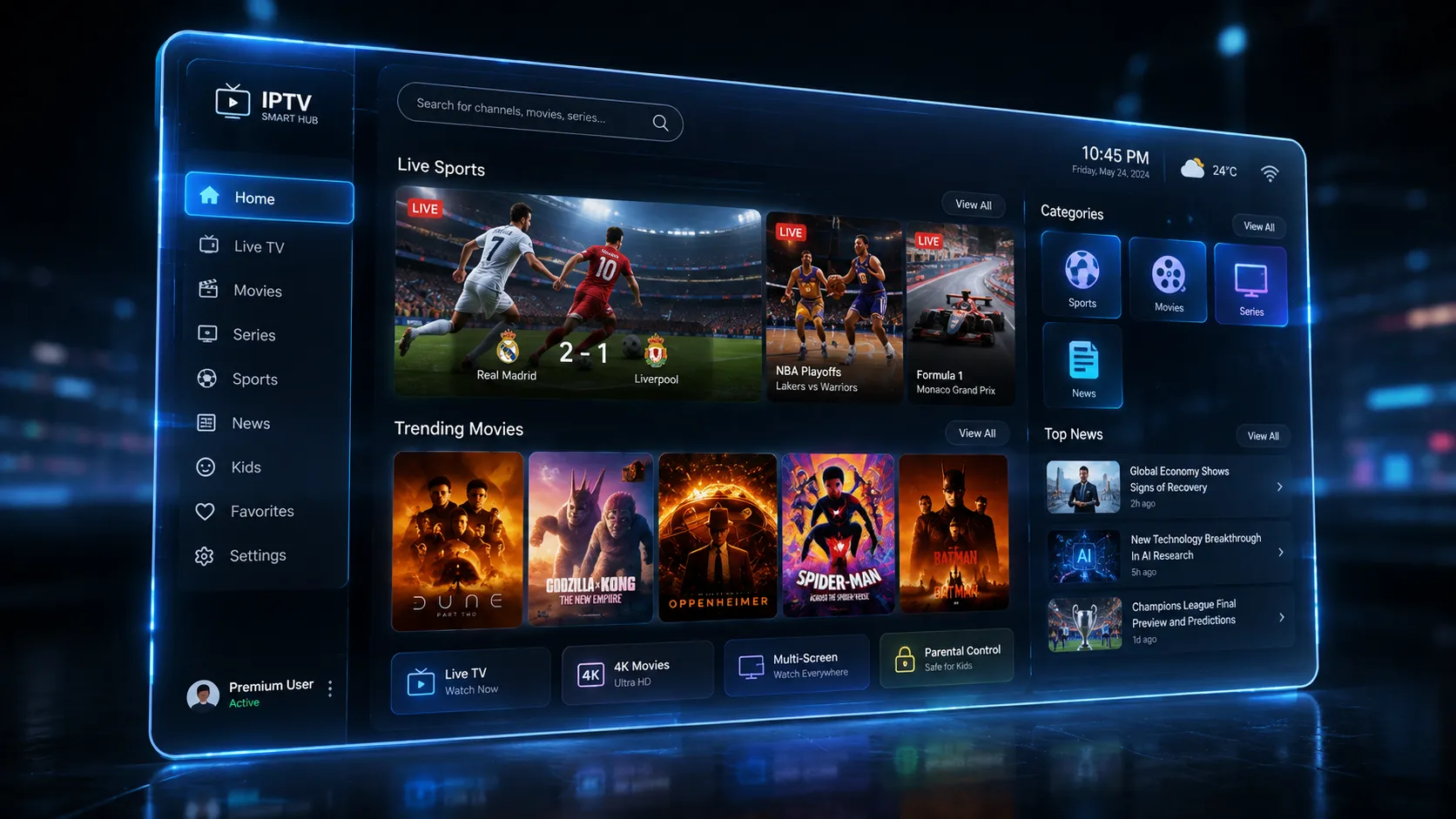
Why Live Sports Places Unique Demands on IPTV Infrastructure
Live sports is categorically different from every other type of content in a provider's library — and understanding why helps you make a better-informed decision when evaluating any IPTV service for sports use.
A film or television series plays to individual subscribers who start it at different times throughout the day. Each stream is independent, and a failure affects one viewer at a time. A live sports event plays to thousands of subscribers simultaneously — all loading the same channel feed at exactly the same moment, typically within the first few seconds of kick-off, tip-off, or the first race lap. This synchronised, simultaneous demand spike is unlike anything else in the IPTV content library, and it is the most demanding test any provider's infrastructure faces.
Providers who have invested in sufficient server capacity, redundant stream sources, and effective load balancing handle these peaks without quality degradation. Providers who have optimised their infrastructure for average load rather than peak demand show their limitations precisely when viewer engagement is highest — at the start of a cup final, during a championship game fourth quarter, at the moment a race becomes decisive.
This is why testing any IPTV service's sports performance requires doing so during an actual live sports event, not simply verifying that sports channels appear in the guide. A channel name present in your EPG and a smooth HD stream at kick-off are different things entirely. For a structured approach to evaluating this during a trial period, see our IPTV free trial evaluation guide.
US Sports: NFL, NBA, MLB, and NHL
For subscribers in the United States, the four major professional sports leagues are the primary reason many people consider an IPTV subscription. Quality IPTV services for the US market carry the main sports broadcast channels and dedicated sports networks that air regular season and playoff coverage for all four leagues.
NFL — the highest-demand sports content in US IPTV
NFL games broadcast across a wide range of network channels, all of which create simultaneous viewer spikes that are especially pronounced on Sunday afternoons when multiple games are airing in concurrent time windows. Sunday Night Football and Monday Night Football create additional weeknight peaks. Playoff weekends — Divisional Round, Conference Championships, and the Super Bowl — represent the absolute highest simultaneous demand events in the US IPTV calendar.
A provider who delivers smooth streams during a standard regular-season Thursday Night Football game is not necessarily one who delivers the same quality during a Sunday afternoon window with six or eight concurrent games being streamed by thousands of subscribers simultaneously. If your trial period overlaps an NFL Sunday, prioritise that as your primary quality test. The result will tell you more about real-world performance than any number of weekday off-peak tests.
NBA, MLB, and NHL
These three leagues distribute games more evenly across the week and across the calendar, which reduces the extreme demand concentration seen with NFL. However, evening games during NBA playoffs, MLB postseason, and NHL playoffs create meaningful concurrent viewer spikes — particularly when high-profile teams or decisive series games are involved. The quality pattern across providers is consistent with NFL: adequate infrastructure holds at normal season demand but shows weaknesses at peak playoff moments.
UK and European Sports: Premier League, F1, Rugby, and Cricket
For subscribers in the United Kingdom, IPTV subscriptions are primarily motivated by access to Premier League football and other premium sports content not available through the UK's free-to-air broadcasting system.
Premier League football
The Saturday 3 PM kick-off window — when multiple Premier League games kick off simultaneously and draw the largest combined viewing audience of the week — is the single most demanding period for UK-focused IPTV infrastructure. A Saturday 3 PM test during your trial period is the most informative single data point available for evaluating a provider's UK sports performance. Sunday lunchtime games, Monday Night Football, and midweek European fixtures create additional demand peaks throughout the season.
Beyond Premier League, the UEFA Champions League, domestic cup competitions, and international fixtures during international windows all concentrate UK viewership at predictable moments. A provider who consistently performs on Saturday at 3 PM will generally serve these other fixtures well too — the reverse is not necessarily true.
For guidance on what good channel coverage looks like for UK sports subscribers, our IPTV channel guide covers the specific channel categories and EPG standards to verify before subscribing.
Formula 1, rugby, cricket, and boxing
Formula 1 race coverage — particularly championship-deciding rounds and races with large UK viewer interest — attracts significant simultaneous streaming spikes from UK subscribers. Six Nations rugby internationals create comparable demand during the early-year competition period. First-class cricket, particularly England internationals, adds summer peaks. Boxing world championship events are the most variable sports category — some IPTV services carry them reliably, others do not at all, and you should verify availability for any specific high-profile event directly with your provider rather than assuming coverage based on general sports channel access.
Network Requirements for Reliable Sports Streaming
Live sports streaming tolerates less latency and less bandwidth variability than any other content category. On-demand content builds ahead in a buffer and plays from that buffer, absorbing brief network fluctuations without visible effect. A live sports stream plays in real time with minimal ahead-buffering — it either receives sufficient, continuous bandwidth or it stutters and freezes. The requirement for consistency is higher than the requirement for raw speed.
- Minimum for HD sports streams: 10 Mbps stable bandwidth measured at your streaming device during peak hours — not peak speed measured on a different device via a browser speed test.
- Recommended for consistently reliable HD sports: 20 Mbps stable on a wired ethernet connection to your streaming device.
- For 4K sports streams: 25–50 Mbps stable on wired ethernet, with a 4K-capable streaming device and a 4K television.
- Wired versus Wi-Fi for sports: A wired ethernet connection is strongly recommended for live sports viewing. Brief Wi-Fi signal fluctuations — caused by interference, distance from the router, or competing devices — produce exactly the momentary bandwidth drops that cause freeze-frames during action sequences. Wired connections eliminate this variable entirely.
What to Verify Before Subscribing for Sports Use
Generic claims about "sports channel availability" from a provider are insufficient basis for a subscription decision. Ask specific questions and verify specific answers before committing.
- Which named channels carry the specific sports leagues and events you watch? Request a channel list, not a category description.
- Are those channels available in HD? Is 4K available for any sports content?
- How does the service perform during peak-demand windows — NFL Sunday afternoons, Premier League 3 PM Saturday, NBA playoff evenings?
- Is PPV content available for boxing, UFC, and major combat sports events? If so, through which channels, and is it included in the standard subscription?
- Can you run your free trial during a live sports broadcast specifically? A provider confident in their sports infrastructure will support this request.
Optimising Your Setup for Live Sports Events
On event day, a set of practical preparation steps reduce the risk of encountering buffering or stream failure at the worst possible moment.
Close all other streaming services and large downloads on your home network at least 30 minutes before the event begins. Background downloads, video calls, and other streaming devices sharing your network all compete for the same bandwidth. Check your streaming device is connected via wired ethernet rather than Wi-Fi. Open your IPTV player and navigate to the sports channel you plan to watch at least five minutes before the scheduled start — loading the stream slightly before the mass concurrent start time reduces the risk of peak-load delays at kick-off.
If buffering starts once the event is already underway, the fastest recovery is to reduce the stream's resolution in your player app's settings from HD to SD temporarily. Once the buffer refills and the stream stabilises, restore the resolution. This is considerably faster than restarting the stream from scratch, which may involve another queue during peak demand.
PPV and Major One-Off Sports Events
Pay-per-view events — boxing world championships, major UFC cards, some NFL international games, and equivalent events in other sports — occupy a category separate from regular season and playoff coverage in the IPTV landscape. Their availability through any given IPTV service depends on the specific event and the provider's source arrangements for that event.
For any specific high-priority PPV event, confirm access with your provider at least one week in advance. Verify the channel and stream quality on the day before the event rather than on the event night itself. Have a backup viewing option in mind — even well-provisioned IPTV services can experience unexpected disruption during events that drive unusually high simultaneous global viewer counts. Planning for contingencies is not pessimism; it is practical preparation for a high-stakes viewing experience.
Choosing a Provider for Sports-First Use
Not every IPTV service is equally suited for sports-primary subscribers. Providers who invest in redundant stream sources for high-demand sports channels, who use dedicated sports channel infrastructure separate from their entertainment streams, and who actively manage load during peak viewing events generally deliver better sports-specific performance than those who treat sports channels as equivalent to any other content in their library.
The most reliable indicator of sports performance is a live test during your free trial. Ask specifically to time your trial to coincide with a live sports event you care about — an NFL Sunday, a Premier League Saturday afternoon, an NBA playoff game. A provider confident in their sports infrastructure will support this request without hesitation. A provider who discourages a sports-timed trial, or who suggests testing during off-peak hours instead, is implicitly acknowledging a weakness at precisely the moments that matter most for sports viewers.
It is also worth asking your provider specifically about redundancy for their sports channels. High-quality sports channels typically have a primary stream and at least one backup stream — often labelled as the same channel name with a different stream ID. When the primary stream encounters a problem during high-demand events, a good player app and a good provider both support quick switching to the backup stream. Knowing that this backup infrastructure exists before you need it during a major final gives you meaningful peace of mind.